
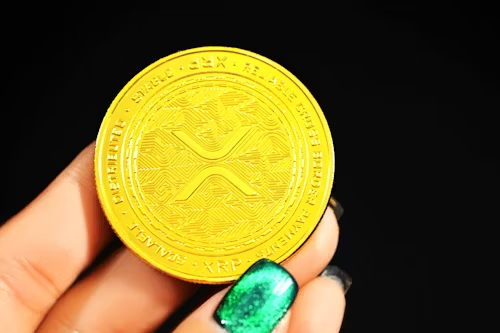
Cryptocurrencies have become part of everyday financial discussions, and XRP is one of the most talked-about names in that space.
If you’ve heard that XRP could change how money moves around the world, you might be wondering: Is XRP a good investment in 2025?
This article explains everything you need to know. You’ll learn what XRP is, how it works, its strengths and risks, and what to consider before investing.
What Is XRP?
XRP is a digital currency created in 2012 by a company called Ripple Labs. Its main goal is to make cross-border payments faster, cheaper, and more efficient than traditional systems like SWIFT or wire transfers.
When you send money across countries through a bank, the process can take several days and include multiple fees. XRP’s system allows transactions to complete within seconds at a fraction of a cent.
Unlike Bitcoin, which uses mining to create new coins, XRP’s entire supply was created at once—100 billion tokens. Ripple holds a large portion of them in escrow, releasing some gradually to maintain stability.
How XRP Works
Imagine you need to send money from the United States to someone in Japan. Normally, banks would process that transfer through several intermediaries, each charging fees. With XRP, the process is nearly instant:
- You exchange U.S. dollars for XRP.
- The XRP moves through the XRP Ledger network in seconds.
- The receiver gets the equivalent amount in Japanese yen almost immediately.
This “bridge currency” function helps financial institutions move value between currencies without maintaining foreign accounts or waiting days for transfers.
Why Some Investors See XRP as a Good Investment
1. Real-World Utility
XRP was built for a practical purpose—cross-border payments. Many cryptocurrencies exist mainly for speculation, but XRP has a defined use case that appeals to banks and payment providers.
2. Speed and Low Transaction Fees
Transactions on the XRP Ledger confirm in about 3–5 seconds and cost less than a penny, making it one of the fastest and cheapest blockchain systems available.
3. Energy Efficiency
Because XRP uses a consensus protocol instead of mining, it consumes minimal energy compared to Bitcoin or Ethereum. This environmentally friendly feature aligns with global sustainability goals.
4. Ripple’s Partnerships
Ripple Labs has established relationships with banks and financial companies worldwide. While not all of them directly use XRP, the partnerships increase awareness and trust in Ripple’s technology.
5. Legal Clarity
After years of legal uncertainty, court rulings clarified that XRP is not a security when traded on public exchanges. This has strengthened market confidence and allowed many platforms to relist XRP.
Why Others Are Cautious About XRP
1. Regulatory Changes
Crypto regulation is evolving. While Ripple’s legal situation has improved, new laws or interpretations in different countries could affect XRP’s use and value.
2. Centralization Concerns
Some critics argue that Ripple controls too much XRP and can influence the market through its holdings. Although the XRP Ledger is decentralized, Ripple’s large reserves create concerns about supply control.
3. Competition
XRP competes with other blockchain systems like Stellar and emerging stablecoins, as well as traditional financial networks updating their technology. Each aims to dominate cross-border payments.
4. Market Volatility
Like most cryptocurrencies, XRP’s price can fluctuate sharply within hours or days. Such volatility makes it risky for short-term investors.
5. Dependence on Ripple’s Success
While XRP can operate independently, its adoption largely depends on Ripple’s business success. Setbacks for Ripple could indirectly impact XRP’s perception and value.
Ripple’s Legal Case Explained Simply
For several years, Ripple Labs faced a lawsuit from the U.S. Securities and Exchange Commission (SEC). The SEC argued that Ripple sold XRP as an unregistered security. This led to uncertainty and temporary delistings from some exchanges.
However, in 2023 and 2024, U.S. courts ruled that XRP itself is not a security when traded by individuals or on exchanges. The decision reduced legal risk and restored investor confidence. Ripple still faced limited penalties for institutional sales but largely resolved the main dispute.
This legal clarity has made XRP appear more stable than during the uncertain years of litigation.
What Could Drive XRP’s Price Higher
- Institutional Adoption: If banks and financial firms adopt XRP for real-world transfers, demand could rise.
- Regulatory Certainty: Clearer global rules make large institutions more comfortable using digital assets.
- Use as Bridge Liquidity: Ripple’s system can provide instant liquidity for international transactions, increasing XRP’s practical use.
- Broader Market Recovery: If the overall crypto market grows, XRP typically benefits alongside major assets like Bitcoin and Ethereum.
What Could Hold XRP Back
- Ripple’s Escrow Supply: Ripple’s large reserves could create downward price pressure if too much XRP enters the market too quickly.
- Competition from New Technologies: New blockchains and stablecoins might offer faster or cheaper solutions.
- Slow Bank Adoption: Financial institutions move cautiously and often need years to update systems.
- Speculative Trading: Many investors treat XRP as a trading asset rather than using it for its intended purpose, creating short-term price swings unrelated to fundamentals.
XRP and Environmental Impact
One advantage XRP holds over many cryptocurrencies is energy efficiency. The XRP Ledger’s consensus system requires only minimal computing power. This makes XRP transactions eco-friendly and scalable; important factors as global financial systems look to reduce their environmental footprint.
Realistic Price Expectations
Predicting XRP’s future price is impossible, but we can outline three general outlooks:
| Outlook | Description | Possible Outcome |
|---|---|---|
| Optimistic | XRP gains wide adoption among banks and becomes a standard bridge currency. | Price could rise significantly over time. |
| Moderate | XRP maintains its current role with gradual growth and limited adoption. | Price remains steady or increases slowly. |
| Pessimistic | Regulatory or competitive issues limit use and investor interest. | Price stagnates or declines. |
Smart Tips for Investing in XRP
- Only Invest What You Can Afford to Lose: Cryptocurrency prices can swing sharply. Keep your exposure limited to an amount you can comfortably handle.
- Diversify Your Portfolio: Combine XRP with other cryptocurrencies or traditional investments to manage risk.
- Stay Informed: Follow reliable sources for updates on Ripple, regulatory changes, and market trends.
- Use Secure Platforms: Choose trusted exchanges and wallets. For long-term storage, consider a hardware wallet.
- Plan Your Strategy: Decide in advance when you would take profit or exit a position. Avoid making emotional decisions based on short-term price changes.
XRP Compared to Other Major Cryptocurrencies
| Feature | XRP | Bitcoin | Ethereum |
|---|---|---|---|
| Transaction Speed | 3–5 seconds | 10–60 minutes | 15–60 seconds |
| Average Fee | Less than $0.01 | Often higher | Variable |
| Energy Consumption | Very low | Very high | Moderate (after upgrades) |
| Primary Purpose | Payments and transfers | Store of value | Smart contracts and decentralized apps |
Should You Invest in XRP?
That depends on your financial goals and your tolerance for risk.
If you believe blockchain will transform international banking and payment systems, XRP represents one of the most direct plays on that idea. However, if you prefer stable, predictable assets, XRP’s volatility may be too stressful.
A balanced investor might view XRP as a speculative but potentially rewarding part of a diversified portfolio something to hold in moderation, not as the foundation of an investment plan.